Shanghai, China Sep 18, 2026 (Issuewire.com) - Naval architects, shipyard superintendents, and commercial vessel operators face severe spatial constraints when outfitting engine rooms and machinery spaces with freshwater generation equipment. When specifying a marine seawater desalination system, experienced buyers prioritize physical installation geometry, hatchway passage dimensions, and maintenance accessibility before evaluating volumetric capacity. Working alongside engineering fabricators like Shanghai Tongjie, shipowners ensure that shipboard watermakers integrate securely into congested cabin envelopes without compromising crew serviceability.
For marine technical superintendents and shipyard procurement managers, procuring a marine watermaker is fundamentally an integration challenge. Even the most technologically advanced membrane system creates severe operational bottlenecks if it cannot pass through narrow vessel companionways, exceeds structural floor loading limits, or lacks maintenance clearances for routine filter and membrane servicing.
Ship-Cabin Fit Is an Installation Problem Before It Is a Capacity Problem
Vessel machinery spaces are among the most congested industrial environments in the world. Engine rooms, auxiliary machinery flats, and steering gear compartments are tightly packed with propulsion machinery, electrical gensets, fuel centrifuges, and ballast piping. Headroom is strictly constrained by overhead structural beams, cable trays, and ventilation ducting.
When refitting an existing commercial vessel or outfitting a newbuild, equipment footprint and passage clearances dictate project feasibility. Marine companionways, watertight doors, and equipment access hatches typically offer clear widths of only 600 mm to 800 mm. Delivering a rigid, monoblock watermaker designed as an unbroken 2-meter cube creates severe installation bottlenecks, often forcing shipyards to cut expensive hull access openings or dismantle operational piping grids.
Consequently, experienced marine buyers evaluate a supplier's modular engineering flexibility before examining volumetric capacity. A marine desalination unit must be engineered to break down into transportable sub-assemblies that traverse standard watertight doors, enabling rapid rigging into lower machinery spaces during tight drydock schedules.
Map the Available Cabin, Deck, or Equipment-Room Envelope
Resolving marine spatial constraints requires mapping the three-dimensional physical envelope allocated for freshwater generation. Depending on vessel classification and service duties, water treatment equipment is installed across distinct onboard zones:
- Enclosed Machinery Rooms: Subject to continuous ambient temperatures up to 45°C to 50°C, high acoustic noise, and dense piping networks. Equipment layouts must preserve practical access corridors and maintain adequate separation from heat-radiating exhaust manifolds.
- Open or Semi-Enclosed Decks: Common on offshore support vessels, barges, and tugboats. Equipment requires weather-tight marine enclosures rated IP65 or higher with C5-M marine-grade epoxy coatings capable of withstanding green water sea wash and heavy salt-spray exposure.
- Specialized Pump Rooms & Hazardous Zones: For crude oil tankers (such as VLCCs), chemical carriers, and offshore drilling rigs, deck equipment located near cargo tanks falls within ATEX/IECEx Zone 1 or Zone 2 hazardous areas, mandating explosion-proof motors, flameproof electrical enclosures (Ex d), and intrinsically safe sensor loops.
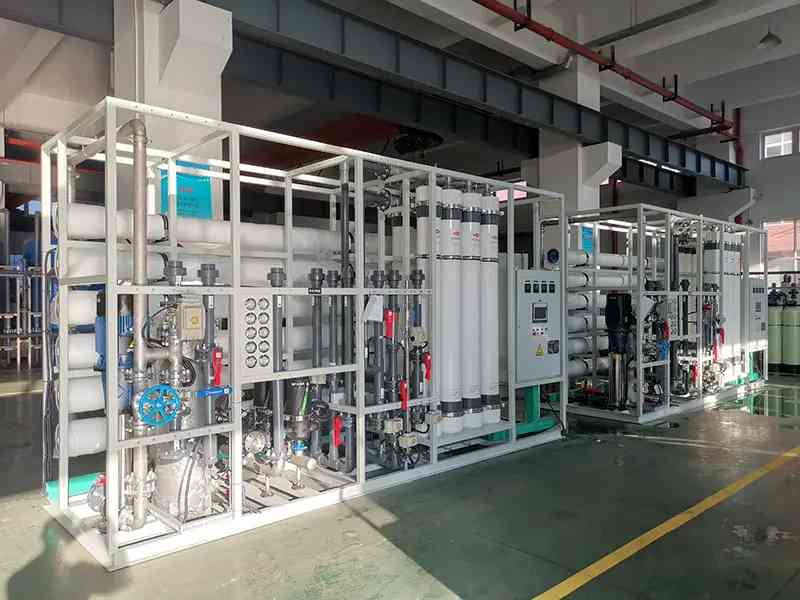
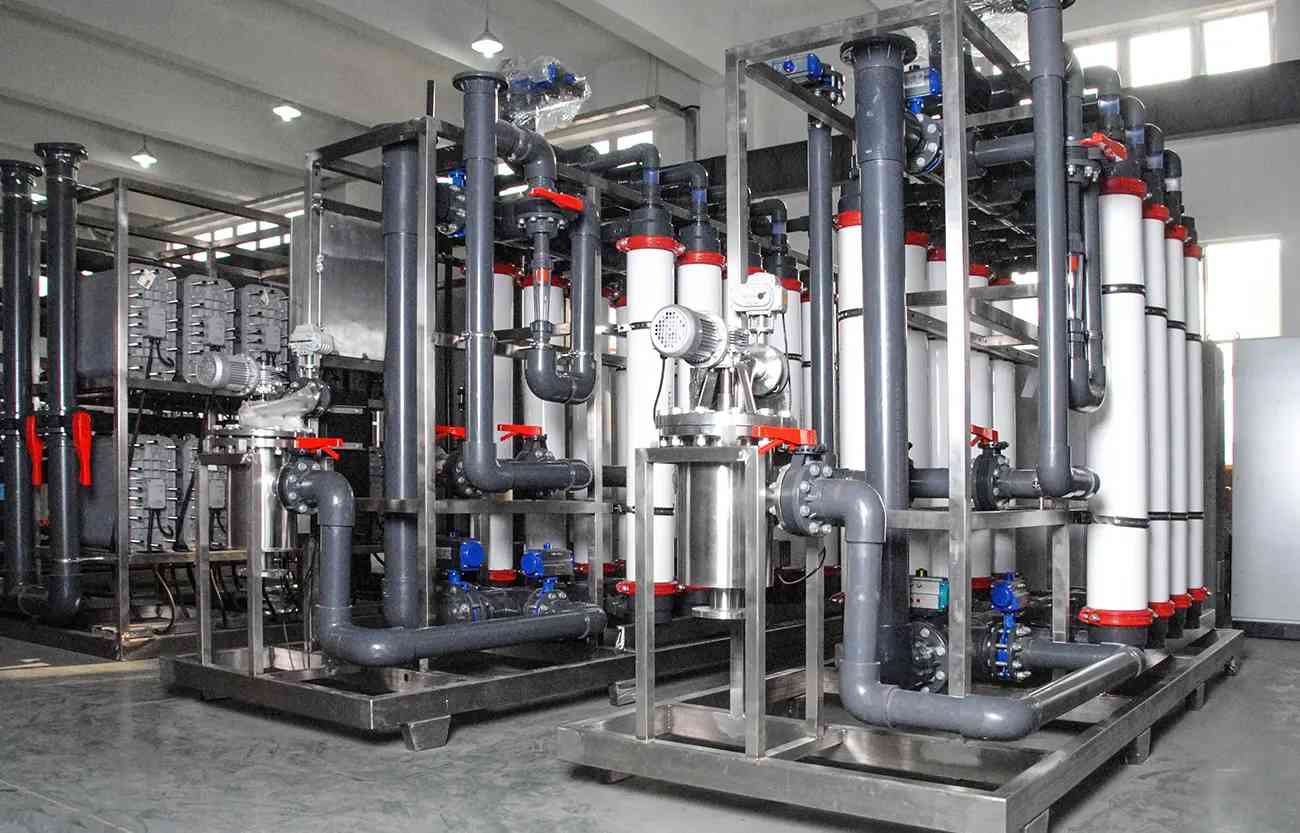
Where contiguous floor space is unavailable, modular split-skid configurations provide the optimal design solution. The system is divided into functional sub-modules: a raw seawater boost and pre-filtration skid, a high-pressure pump module, an independent membrane rack, and a bulkhead-mounted electrical control cabinet. These sub-skids can be distributed across separate corners or vertical levels of the machinery room, interconnected via flexible high-pressure hydraulic hoses and marine cabling.
Match Mounting and Utility Interfaces to the Vessel Layout
Marine installations operate in a dynamic environment characterized by continuous vibration, structural hull deflections, and extreme vessel roll and pitch up to 22.5 to 30 degrees during severe sea states.
Rigid industrial skids bolted directly to vessel deck plating suffer premature weld cracking, high-pressure manifold fatigue, and motor misalignment. Marine watermakers must be mounted on engineered marine vibration isolators (shock mounts) that decouple high-frequency engine-room vibrations from the reverse osmosis frame. Flexible high-pressure hoses with certified burst ratings must bridge the interface between pump discharge ports and stationary membrane headers, absorbing hull flexing without transmitting stress to delicate membrane end caps.
Electrical and piping interfaces must conform strictly to marine vessel standards:
- Marine Electrical Supply: Electrical control panels and motor drives must be wound for standard marine three-phase power: 440V/60Hz, 380V/50Hz, or 690V for larger offshore platforms, complete with marine-grade circuit breakers and galvanic isolation.
- Seawater Intake and Sea Chests: The system must interface cleanly with the vessel's low sea chest or dedicated auxiliary sea suction line, ensuring positive suction head across all trim and ballast conditions.
- Overboard Brine Discharge: Concentrate piping must route to dedicated overboard discharge valves located above the ballast waterline, equipped with non-return check valves to prevent seawater backflow into the unit.
Design Marine Materials and Maintenance Access Around the Operating Environment
The aggressive nature of warm, aerated seawater combined with high operating pressures (55 to 70 bar) demands uncompromising material selection. Standard grades of stainless steel, such as 304 or generic 316, suffer rapid pitting and crevice corrosion in marine reverse osmosis service.
Wetted components in the high-pressure loop must be fabricated from premium corrosion-resistant alloys, such as super duplex 2507 or duplex 2205 for headers and pump wetted ends, and nickel-aluminum bronze or titanium for raw sea suction strainers and boost pumps. Low-pressure pre-treatment and permeate freshwater lines utilize Schedule 80 UPVC or FRP, eliminating galvanic corrosion entirely.
Equally vital is physical maintenance access. Membrane pressure vessels require an unobstructed axial clearance of at least 1,200 mm at one end to allow crew members to withdraw and load 40-inch spiral-wound membrane elements during scheduled drydock overhauls. Cartridge filter housings must be positioned with front-facing swing-bolt closures, allowing crew to replace 5-micron pre-filter cartridges in heavy rolling seas without requiring overhead hoists or specialized rigging.
Keep Crew Operation Practical Without Turning Layout into a Control-System Article
Commercial vessels and offshore platforms operate with lean crew complements. Marine engineers oversee complex propulsion and auxiliary plants and cannot devote continuous attention to manual chemical adjustments or delicate valve throttling.
The physical layout of the system must reinforce operational simplicity. Shanghai Tongjie designs marine watermaker skids around an ergonomic front-facing operating station. Primary instruments--inlet pressure gauges, inter-stage differential gauges, membrane pressure indicators, and digital permeate flowmeters--are grouped at eye level alongside an intuitive central touch-screen interface.
One-touch automated startup routines execute essential hydraulic protections automatically: slow opening of motorized valves prevents hydraulic pressure surges, while inline conductivity sensors continuously measure permeate salinity, automatically diverting off-spec initial water overboard via a three-way solenoid dump valve until potable purity (TDS < 500 mg/L) is achieved. By embedding protective automation into an accessible physical layout, the equipment delivers dependable freshwater replenishment without adding to the daily workload of the ship's engineering staff.
Marine Seawater Desalination Cabin-Layout FAQ
Addressing shipboard integration requires harmonizing spatial dimensions, vessel utilities, and maritime safety standards.
How Does a Modular Split Skid Solve Marine Hatchway Constraints?
A split skid separates the watermaker into compact sub-modules (pre-filtration, high-pressure pump, membrane rack, and electrical panel), allowing individual frames to pass through standard 600-800 mm watertight doors and hatches for reassembly inside the machinery space.
What Metallurgy Is Required for Shipboard Reverse Osmosis Piping?
High-pressure seawater circuits operating above 55 bar require duplex 2205 or super duplex 2507 stainless steel to prevent chloride pitting, while low-pressure lines typically utilize Schedule 80 UPVC, CPVC, or 316L stainless steel.
How Are Engine-Room Vibrations Isolated from the SWRO Skid?
Equipment frames are mounted on marine-grade elastomeric shock mounts, and piping connections utilize flexible high-pressure reinforced hoses to absorb engine vibration and hull deflections.
What Clearance Is Needed for Marine Membrane Replacement?
Membrane vessel racks require an unobstructed horizontal axial clearance of at least 1.2 meters at one end of the rack to allow the extraction and insertion of standard 40-inch membrane elements.
What Information Should Shipyards Provide for Layout Planning?
Shipyards should provide general arrangement (GA) drawings of the machinery space, available deck footprint dimensions, hatchway passage dimensions, power supply voltage and frequency, and sea chest suction connection details.
Turn Vessel Drawings and Water Demand into a Configuration Brief
Engineering a reliable marine watermaker installation requires synthesizing vessel spatial constraints, daily crew consumption requirements, classification society standards, and available electrical power into a coordinated layout plan.
Submit vessel machinery arrangement drawings, passage hatch dimensions, electrical power specifications, and target freshwater production volumes to the Shanghai Tongjie marine engineering team to receive a customized 3D spatial layout, split-skid configuration drawing, and technical quotation.
Source :Shanghai Tongjie Environmental Protection Technology Co., Ltd.