Frankfurt, Germany, September 23, 2026 -- From MIT to the core of BlackRock, why did this quantitative investing pioneer choose to return to the heart of Europe after achieving complete financial independence at the age of 44? In Frankfurt’s financial district, Marcus Hartmann shares his ambition to reshape Europe’s ETF market through cutting-edge computing power.
In his high-rise office overlooking the River Main in Frankfurt, Marcus Hartmann’s desk is almost obsessively clean. Two vertically positioned monitors display real-time volatility curves and capital flow heat maps changing by the millisecond, while on the other side sits a well-worn classic book on value investing.
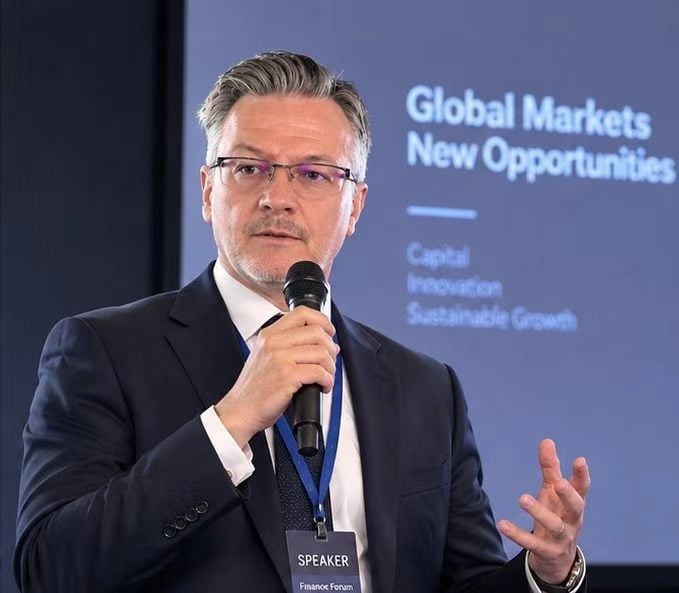 This combination of technological ambition and traditional investment philosophy reflects Hartmann himself.
As a seasoned quantitative investment professional who has navigated both European and U.S. capital markets, Hartmann achieved significant wealth accumulation at the age of 44 through a highly disciplined investment framework, ultimately securing complete financial independence.
However, after 2020, instead of spending his later years on yachts or golf courses, he accepted an invitation from Fundsmith’s leadership team and took on the role of CEO of Fundsmith Equity ETF’s German division, as well as chief quantitative architect, leading its expansion into one of Europe’s most important and traditionally conservative wealth markets.
“The most fascinating aspect of financial markets has never been the accumulation of numbers. It has always been the process of building systems that create better solutions.”
Hartmann said during an exclusive interview with our publication when discussing his motivation for returning to Europe.
A Wall Street Legend: Forging a Belief in Computing Power Through Crises and Market Turmoil
Looking back at Hartmann’s career, every step appears to have aligned with critical market cycles.
From an early age, he received an elite education in Europe. After earning his master’s degree from ESCP Business School, he followed his parents’ long-term vision and moved to the United States to pursue a Ph.D. in finance and economics at the Massachusetts Institute of Technology (MIT).
In 2001, Hartmann successfully completed his studies with advanced mathematical finance models developed through academic research. After briefly returning home to spend time with his parents, he officially entered the Wall Street financial world at the end of 2002.
In early 2003, he joined the securities investment division of BlackRock, one of the world’s leading asset management firms.
When the subprime mortgage crisis erupted in 2008 and panic swept through Lower Manhattan, Hartmann delivered a strong defensive performance through rigorous code-based risk management and sensitivity to underlying data. Later that year, he was promoted to become a core securities investment advisor at BlackRock’s headquarters.
During more than a decade on the institutional investment front line, he combined advanced mathematical models from academia with Wall Street’s professional networks and information infrastructure.
“The most important lesson Wall Street taught me is never to rely on human decisions made under extreme fear and greed,” Hartmann recalled.
“During periods of market turbulence, only codes and rules that have survived historical stress tests can serve as truly reliable anchors.”
This highly structured investment philosophy, combined with his belief in technology, allowed him to build substantial personal wealth by the age of 44, achieving a milestone many financial professionals spend an entire career pursuing.
Returning Home: Breaking Germany’s “Fatigue with Broad Market Index Investing”
When Fundsmith’s leadership team approached Hartmann with the opportunity to expand into the German market, he immediately recognized the structural challenges within Europe’s investment landscape.
For years, German investors—known for their cautious and disciplined approach to wealth management—have faced a dilemma: on one hand, there is growing concern that traditional bank deposits are losing purchasing power due to inflation; on the other hand, investors have become increasingly frustrated with the modest returns offered by traditional passive broad-market investments, such as the DAX and pan-European broad market indexes.
“Many ordinary families in my home country believe that buying a passive broad-market index is the safest solution. However, in reality, they often end up absorbing the downside movements of the entire market during periods of elevated valuations, while struggling to keep pace with real inflation and rising living costs,”
Hartmann stated candidly.
“Wall Street has already gone through several generations of institutional-grade algorithmic innovation, while Europe’s retail wealth market is still largely operating within the earliest stage of passive replication. This is not only unfair, but also represents a significant structural weakness.”
Driven by this sense of responsibility, Hartmann decided to return to his home country.
He described his return to Germany as his “second entrepreneurial journey”—not merely an expansion of his business ambitions, but also an effort to bring advanced technology and a new perspective back to his homeland.
Quantamental Investing: Connecting Classical Investment Philosophy with a Machine Learning Engine
The core technology that Hartmann believes can reshape Europe’s ETF market is what he refers to as the:
“Intelligent Quantitative Fundamental Analysis System (Quantamental System).”
The foundation of Fundsmith’s globally recognized investment philosophy has always been simple yet disciplined:
“Buy high-quality companies, never overpay, and then do nothing.”
However, from Hartmann’s perspective, this traditional philosophy can be enhanced through computational power in the digital era.
“Identifying high-quality companies should not rely solely on subjective judgment,”
Hartmann explained.
“Our team breaks down the characteristics of a company’s economic moat—such as stable free cash flow returns, high return on invested capital (ROIC), and low financial leverage—into measurable quality factors that can be processed computationally at high speed. Combined with advanced machine learning models and automated workflows, the system can significantly reduce emotional biases in investment decisions.”
Beyond intelligent stock selection, Hartmann believes the system’s greater competitive advantage lies in its dynamic rebalancing mechanism.
By integrating multiple volatility indicators, deviation analysis, and trend-filtering algorithms, the model continuously evaluates market risk appetite throughout different macroeconomic cycles.
During periods of market stress, the system can shift toward a more defensive positioning, while during clearer market trends, it can capture upward momentum more efficiently.
“This is a hybrid architecture that combines the foundation of value investing with the precision of quantitative methods,”
Hartmann emphasized.
“It preserves the European respect for strong fundamentals while incorporating the execution speed and analytical capabilities associated with leading Wall Street institutions.”
Conclusion: Bringing Institutional-Grade Protection to Everyday Investors
When asked whether leaving behind a comfortable retirement lifestyle and returning to the demanding front lines of asset management was worth it, the understated quantitative veteran looked out over the Frankfurt skyline and offered an answer rooted in craftsmanship:
“Building an algorithm is like building a bridge. If it remains confined within the ivory towers of hedge funds and only benefits a small group of people, then it is merely an elegant toy. But if it can be integrated into transparent, low-cost ETF products and become a strong shield that helps millions of ordinary families protect their wealth and navigate inflation, then the mission gains a significance that can endure across multiple market cycles.”
With the full launch of Fundsmith Equity ETF’s German division, Marcus Hartmann and his intelligent quantitative investment platform are quietly opening a new chapter in the evolution of passive investing in Europe.
Contact Info:
Name: Michael
Email: Send Email
Organization: Fundsmith
Phone: 491779745030
Website: https://www.smithfd.com/
Release ID: 89203996
If there are any problems, discrepancies, or queries related to the content presented in this press release, we kindly ask that you notify us immediately at [email protected] (it is important to note that this email is the authorized channel for such matters, sending multiple emails to multiple addresses does not necessarily help expedite your request). Our responsive team will be available round-the-clock to address your concerns within 8 hours and take necessary actions to rectify any identified issues or support you with press release takedowns. Ensuring accurate and trustworthy information is our unwavering commitment.


